
How AI Is Transforming Pediatric Healthcare
Summarize this article with:



- 1. How AI Is Changing Pediatric Healthcare
- 1.1 AI-Assisted Diagnosis and Early Detection
- 1.2 Predictive and Preventive Pediatric Care
- 1.3 Personalized Pediatric Care
- 1.4 Smarter Growth and Development Monitoring
- 1.5 AI-Powered Vaccination and Follow-Up Management
- 1.6 AI-Powered Clinical Documentation
- 1.7 AI-Powered Pediatric Practice Management
- 2. Embracing AI for Smarter Pediatric Healthcare
- 3. FAQs
99% Indian pediatricians admitted that AI brings drastic positive impact in pediatric practices. AI in pediatric healthcare is moving beyond simply converting repetitive task into automation.
It is becoming a tool that manages large amounts of patient data, supports clinical decisions, identifies potential health risks and creates smoother experiences for both pediatricians and families.
But before integration of AI in pediatric care, child experts seem struggling to manage large patient volume along with other clinical operations. So, the path to achieve pediatric workflow automation goes through adapting AI in child healthcare practices.
In this article, we will unpack game-changing applications of AI in pediatrics that have tremendously generated better health outcomes.
How AI Is Changing Pediatric Healthcare
Ever wonder how artificial intelligence in pediatrics can give a revolutionizing effect? Some of these practical use cases of AI in child healthcare can give answer to this question.
Simplify solo pediatric practice management with smart, all-in-one software.
AI-Assisted Diagnosis and Early Detection
AI in pediatrics allows experts to identify the actual disease by referring to symptoms, lab results, vitals or diagnostic images. Without AI experts need to manually interpret symptoms, and other medical records.
On the other hand, AI can also support early disease detection before the situation has not yet entered the danger zone. By considering stored medical data, it can identify abnormal patterns, related risks and suggest doctor to carry out further evaluation.
Predictive and Preventive Pediatric Care
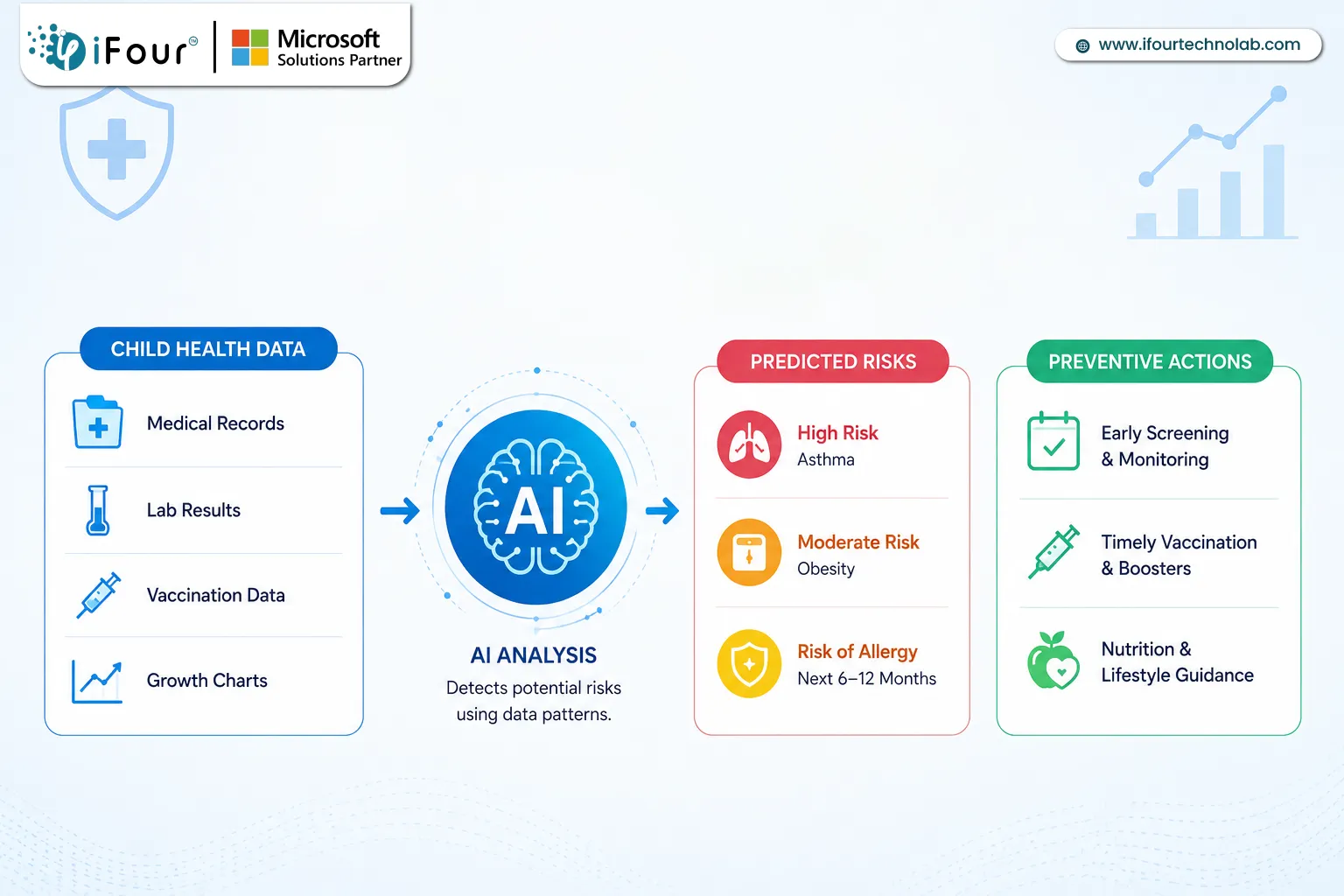
AI in pediatric healthcare, interprets the stored medical records including histories, lab results, diagnostic images, vaccination data, visit summaries and growth charts to detect health risk that might take place in future.
AI-based predictive analytics in pediatrics can help doctors to take necessary preventive care actions. AI can enforce data-driven pediatric care more effectively.
Personalized Pediatric Care
Pediatricians can personalize care for every child individually without AI support but that requires them to review each child deeply and then decide what plan will work.
But through AI contribution, pediatricians get a well-structured care plan which is tailored according to every child’s health situation. Instead of one, AI can provide multiple suitable plans, and it also allows experts to make changes if required.
Optimize neonatal and infant care with intelligent clinical workflows
Smarter Growth and Development Monitoring
AI can simplify pediatric patient monitoring in terms of growth and development assessment by:
- Detecting abnormal growth pattern
- Finding changes in growth between 2 corresponding visits
- Generating detailed development report with organized information
- Calculating long-term progress
So, AI makes growth and development evaluation more efficient compared to manual processes.
AI-Powered Vaccination and Follow-Up Management
A pediatric clinic needs to manage vaccination schedules, records, tracking and reminders in order to maintain consistency in child’s medical journey.
With AI support, vaccination management can be carried out effectively.
AI in pediatrics can:
- Provide suggestions related to schedule
- Send reminders for due & overdue doses
- Maintain detailed record of every vaccine
- Track status of every dose
AI-Powered Clinical Documentation
In pediatrics workflow, documentation requires lots of time to be invested. Manual constructing each clinical document from scratch can generate human errors.
But with AI, every clinical document can be generated by following a universally accepted format. It also ensures the accuracy of documents and allows pediatricians to invest their time in more meaningful tasks.
Expand child healthcare access with integrated telehealth and virtual visits.
AI-Powered Pediatric Practice Management
Pediatric practice management refers to the operational and administrative side of pediatric practice.
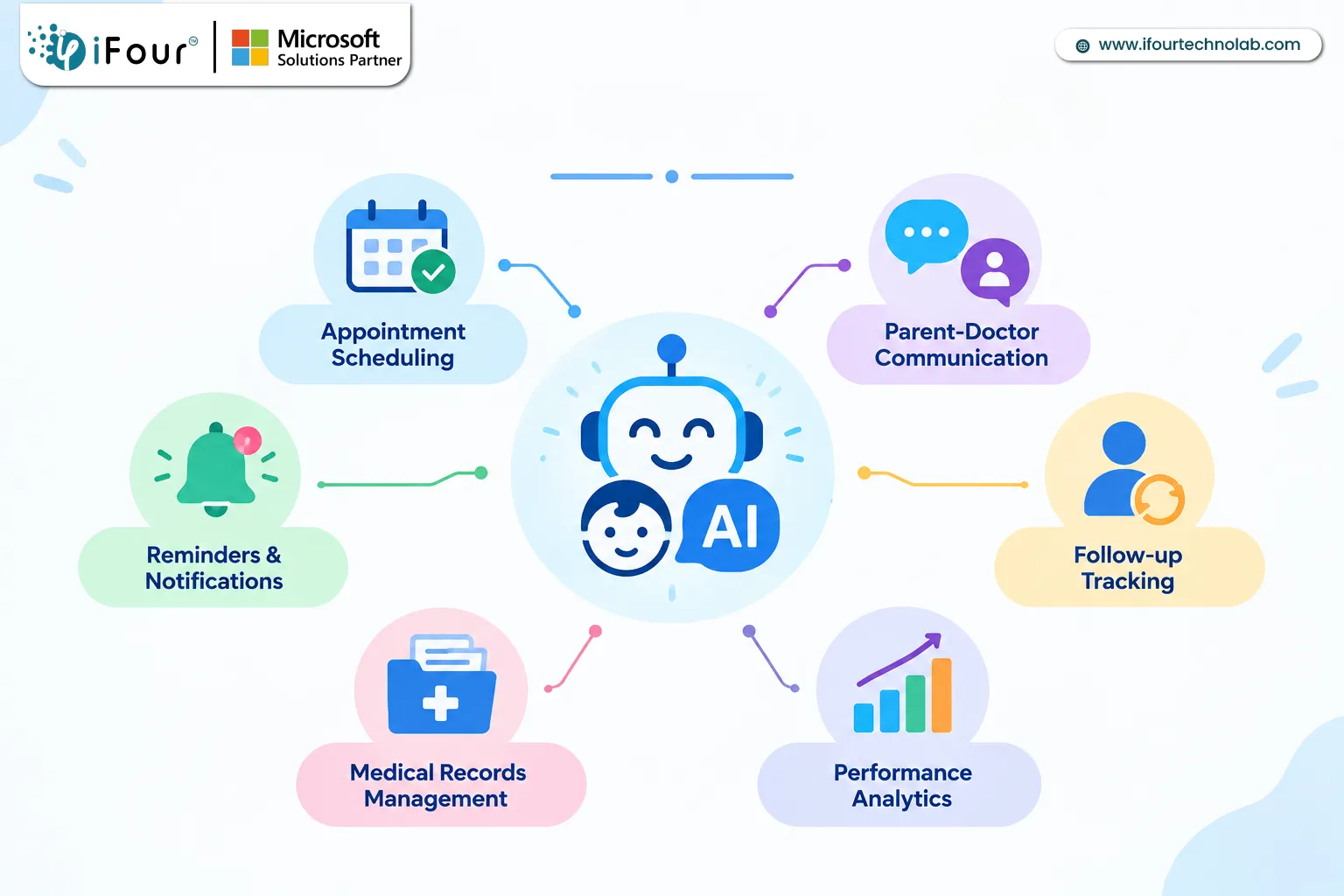
AI in child healthcare can streamline pediatric practice management by:
- Suggesting proper slots after verifying expert availability and parent convenience
- Supporting effective parent-doctor communication
- Automating reminders and notification for upcoming visit or vaccinations
- Identifying patients that are due for follow-up
- Managing large volume of medical records in an organized and easy to accessible manner
- Providing detailed analysis of real-time performance regularly
Embracing AI for Smarter Pediatric Healthcare
AI is transforming pediatric healthcare by adapting more smarter, dynamic and advanced approaches that can allow pediatricians more time and capacity to create a good connection with the little patients.
AI can develop digital pediatric healthcare system through assisting diagnosis, contributing growth & development monitoring, streamlining vaccination, supporting documentation and connecting entire workflow.
The goal of adapting AI in pediatrics was not to replace pediatricians but to amplify their strengths and eliminate their weaknesses.
FAQs
Yes, pediatric healthcare technology such as AI can help pediatricians diagnose diseases by analyzing symptoms, medical histories, test results, and other patient data to identify patterns that may be difficult to detect manually. AI can flag potential health risks and provide clinical decision-support insights, while the pediatrician reviews these findings and makes the final diagnosis.
Yes. AI can help monitor children’s growth and development by analyzing information such as height, weight, BMI, head circumference, growth trends, and developmental milestones over multiple visits.
AI can help with pediatric vaccination management by analyzing a child’s vaccination history, age, previous doses, and upcoming appointments to identify vaccinations that may be due or overdue.
Yes. AI can reduce the workload of pediatricians by taking over or assisting with repetitive administrative and information-heavy tasks, allowing pediatricians to spend more time on clinical care and communication with children and parents.
Yes. AI can support personalized pediatric care by analyzing a child’s individual health information and helping pediatricians understand patterns that may be difficult to identify manually.
.webp)
Recent Posts

Why Paper Records Are Holding Pediatric Clinics Back?
September 03, 2026
Everything You Need to Know About Pediatric SOAP Notes
August 27, 2026How AI Is Transforming Pediatric Healthcare
August 25, 2026
HIPAA vs Indian Healthcare Data Regulations
August 24, 2026