How do HIPAA and GDPR affect SaaS?
Summarize this article with:



Developing a healthcare SaaS product is quite fascinating. You take care of the required functionalities, focus on user experience ensuring everything runs smoothly and reliably on the web and across devices.
But one question can’t be overlooked while developing a SaaS tool: the sensitive data your platform handles. From EMR to medical histories to personal information, healthcare products process data that requires strict protection.
At this point, legal regulations like HIPAA and GDPR come into the frame. These standards basically ensure how a SaaS platform should use data so that privacy and security are maintained.
To know how HIPAA and GDPR compliance impacts the SaaS product development, then continue reading this article.
What Is HIPAA and GDPR?
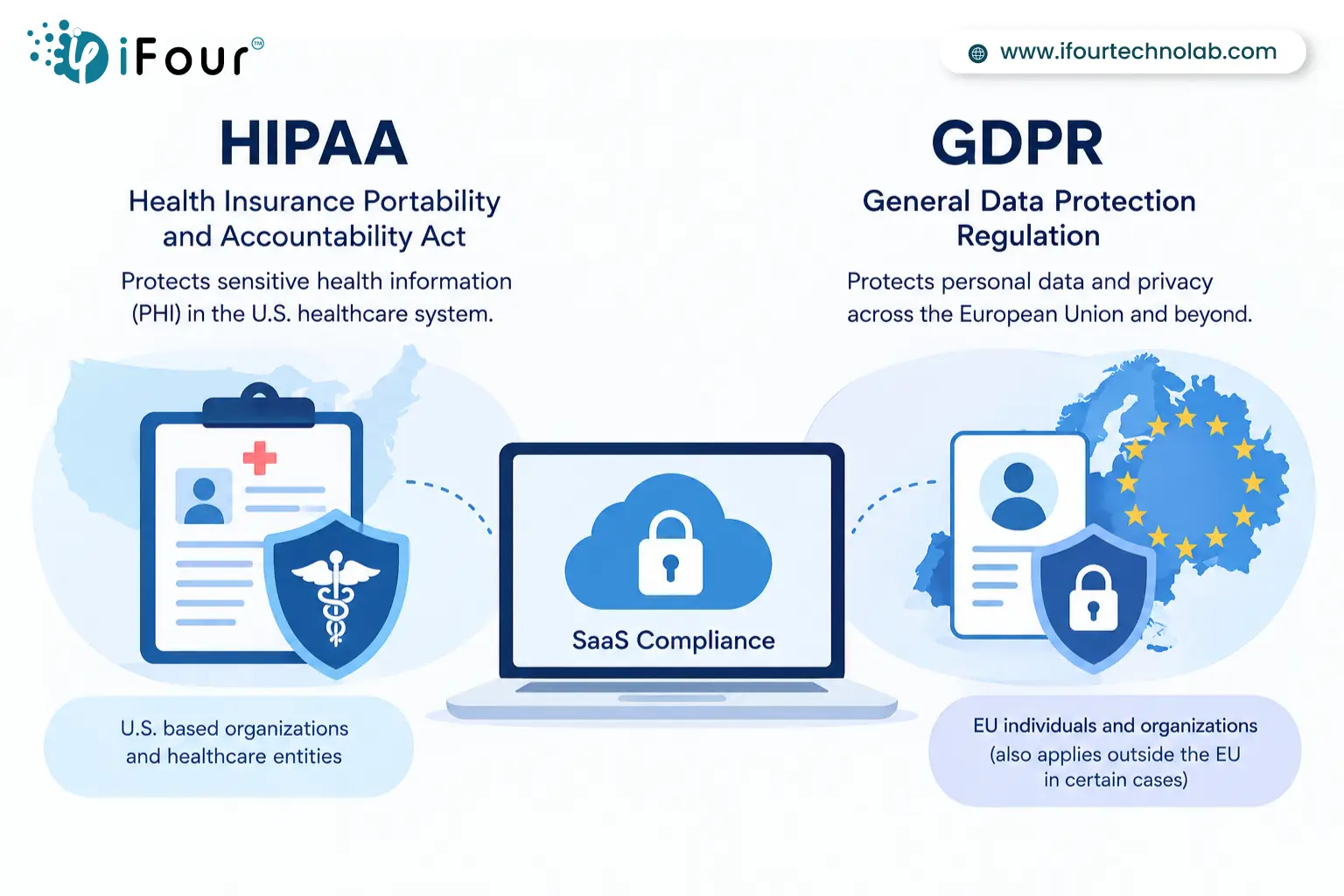
HIPAA and GDPR are regulatory standards that formulate the rules regarding how to collect, process, store, share and protect sensitive data. For SaaS compliance requirements it is necessary to adhere with these regulations.
Empower community health clinics with smarter pediatric software solutions
What is HIPAA?
Health Insurance Portability and Accountability Act (HIPAA), consists of laws regarding safe usage of protected health information (PHI) by covered entities and business associates.
It basically limits to U.S based organizations which work with sensitive health data.
What is GDPR?
General Data Protection Regulation (GDPR) is a strict data privacy law established by European union in concern to protect personal data.
Unlike HIPAA, which is defined only as healthcare domain, GDPR supports broader areas. If any organization that works with personal data of EU people or offers services or products to them then it directly comes under GDPR.
Read More : How AI Is Transforming Pediatric Healthcare
HIPAA and GDPR for SaaS can shape how organizations approach data security, privacy and the handling of sensitive information.
Adhering to HIPAA and GDPR compliance for SaaS platform requires more attention as both execute different frameworks from their end.
How Does HIPAA Affect SaaS?
Once sensitive health information enters SaaS platform, HIPAA becomes important part of deciding how that data should be handled and protected.
Protecting PHI in SaaS Applications
When a SaaS application handles Protected Health Information (PHI), it needs to protect that information from unauthorized access, disclosure, alteration, or loss.
This is especially important for healthcare SaaS platforms that manage patient records, medical reports, diagnoses, treatment information, or billing-related health data.
SaaS providers should ensure security by considering:
- Secure data storage
- Encryption
- Access controls
- Authentication
- Regular backups
Business Associate Requirements
When a SaaS organization provides services to entities lying under HIPAA then it officially becomes a business associate.
As a business associate HIPAA compliant SaaS provider needs to have appropriate safeguards in place to protect PHI. This can involve:
- Enforcing proper security measures to prevent illegal PHI access, disclosure or alteration
- Ensuring subcontractors or third-party vendors are abiding to required regulations
- Informing the affected parties in case of their PHI violation
Besides all this, SaaS providers need to sign a Business Associate Agreement (BAA) to bind them legally.
Reduce paperwork with digital EMRs built for pediatric practices.
Security and Risk Management
Under HIPAA, SaaS providers handling ePHI need appropriate administrative, physical, and technical safeguards. This involves more than simply securing the application itself.
SaaS platform must follow following measures in terms of security and risk management:
- Risk assessment: Identify where ePHI could be exposed, lost, altered, or accessed without authorization.
- Risk prevention: Execute access control, authentication, auditing, encryption and data recovery mechanisms to avoid violation of PHI.
- Risk notification: Notify affected parties and authorize people if any violation occurs.
- Compliance and security review: Reassess risks and update security measures as the SaaS environment, technology, and threats change.
HIPAA Breach Responsibilities
As a part of HIPAA compliance for SaaS, businesses need clear breach notification process in case sensitive health data get exposed.
The breach responsibilities for SaaS providers include:
- Detecting breach
- Investigating the incident
- Notifying the covered entities
- Documenting the incident
- Taking corrective actions
How Does GDPR Affect SaaS?
When your SaaS platform collects personal data from people in the EU, GDPR can influence what you collect, why you collect it and what happens to it afterward.
Collecting and Processing Personal Data
Under GDPR, SaaS companies need to pay attention to what personal data they collect, why they collect it, and how they use it.
Personal data can include names, email addresses, phone numbers, IP addresses, location information, and other information that can identify an individual.
GDPR compliant SaaS companies collect only the personal data they need, have a valid reason for using it, clearly explain what they are doing with it, and protect it properly.
SaaS Provider as a Data Processor
SaaS provider can act as a data processor when it processes personal data on behalf of a customer (the data controller) and according to the customer’s instructions.
SaaS companies should assist customer, manage sub-processors (by ensuring they are following the GDPR guidelines), protect personal data and return the data when it is not needed.
The relationship between data processors and data controllers should be documented through an appropriate Data Processing Agreement (DPA).
Keep recovery journeys visible with centralized pediatric recovery monitoring
Supporting Data Subject Rights
A SaaS company should provide appropriate ways for customers to help them exercise the rights which they have on their personal data.
Under GDPR, individuals have certain rights related to:
- Right to access
- Right to rectification
- Right to erasure
- Right to restrict processing
- Right to data portability
- Right to object
- Rights related to automated decision making
For a SaaS platform, supporting these rights may involve building features such as data export, account/data deletion workflows, profile editing, and tools for administrators to locate and manage a person’s data.
GDPR Security and Privacy Requirements
GDPR requires SaaS companies to protect personal data and build privacy into their products from the beginning.
This includes using appropriate security measures such as encryption, access controls, authentication, monitoring, and backups.
SaaS platforms should also collect only necessary data, use privacy-friendly default settings, and manage personal data securely throughout its lifecycle—from collection to deletion.
International Data Transfers
International data transfer requirements mean a SaaS company cannot simply move GDPR-protected personal data to another country without considering whether the transfer is legally permitted and adequately protected.
The SaaS company needs to consider whether the transfer is permitted under GDPR and whether appropriate safeguards are in place.
GDPR compliance for SaaS companies includes verifying where customer data is transferred, stored and processed.
Help specialists deliver better care with centralized pediatric management software
The Importance of HIPAA and GDPR Compliance for SaaS
HIPAA and GDPR compliance are important for SaaS companies that handle healthcare or personal data because it helps ensure that sensitive information is collected, processed, stored, and shared securely and responsibly.
For healthcare SaaS providers, HIPAA compliance is particularly important when handling protected health information, while GDPR compliance becomes relevant when processing personal data within the regulation’s scope.
Building these requirements into the SaaS product and its operations from the beginning can also support customer trust and make it easier to meet contractual and regulatory expectations as the business grows.
FAQs
Yes, a SaaS platform can be designed to meet both HIPAA and GDPR requirements when applicable. However, compliance with one does not automatically mean compliance with the other.
A SaaS company may need a Business Associate Agreement (BAA) when it qualifies as a HIPAA business associate and handles protected health information (PHI) on behalf of a HIPAA covered entity or another business associate.
Yes, when a SaaS company acts as a data processor for a customer, GDPR generally requires a data processing agreement (DPA) between the processor and the data controller.
The main difference is what each regulation protects and whom it applies to. HIPAA is primarily focused on protecting health information within the U.S. healthcare system, while GDPR provides broader rules for protecting personal data and privacy when its territorial requirements are met.
Yes. GDPR can apply to SaaS companies located outside the EU when their data-processing activities fall within the regulation’s territorial scope. GDPR is based on the nature and scope of certain data-processing activities, not simply on where a SaaS company’s headquarters are located.
.webp)
Recent Posts
AI In Pediatric Practice – Pros and Cons
September 25, 2026How do HIPAA and GDPR affect SaaS?
September 25, 2026
Pediatric Billing Challenges and How to Overcome Them
September 22, 2026
Benefits of Cloud-Based Pediatric Practice Management Software
September 14, 2026