
HIPAA vs Indian Healthcare Data Regulations
Summarize this article with:



As a healthcare provider, you can control how you treat patients – but managing their data is governed by privacy laws.
Healthcare is universal, yet data protection rules differ across countries.
Let’s understand with an example: A hospital serving patients in both the USA and India cannot handle their records in the same way.
HIPAA in the U.S. and India’s healthcare data standards each set strict requirements for patient privacy.
Running services across these geographies means complying with both frameworks, without compromise.
Let’s move further and learn the differences between HIPAA and Indian healthcare data regulations to help you keep your practice compliant.
What is HIPAA?
HIPAA (Health Insurance Portability and Accountability Act) 1996 is a law established for protecting patient medical data. It gives rights to Health and Human services of US department for constructing rules and regulations regarding safeguarding patient information.
HIPAA focuses on ensuring the security of Protected Health Information (PHI).
Make pediatric care more accessible with integrated telehealth features.
It consists of 4 major components:
- Privacy rule: Manages how PHI must be used and provides some rights to patients for controlling their health data.
- Security rule: Safeguards the ePHI from cyberthreats and illegal access.
- Breach notification rule: Notify affected party, authorities and media (if required) when PHI is compromised.
- Enforcement rule: Suggest how to investigate, how to charge penalties and how to enforce HIPAA requirement.
Healthcare organizations, medical claim clearing houses, medical plans and business associates who deal with PHI all must be responsible towards HIPAA regulation.
India’s Healthcare Data Protection Framework
Unlike US, India does not have single healthcare data protection standard. Instead, a combination of multiple regulations is responsible for ensuring medical data security.
India’s healthcare data protection framework consists of:
- Digital Personal Data Protection Act 2023: This regulation controls how healthcare entities and services collect, use, store and share digital personal data.
- ABDM (Ayushman Bharat Digital Mission) Health Data Management Policy: This is one of the legal standards established for protecting patient health records within digital healthcare ecosystem of India.
- Information Technology Act, 2000 and applicable rules: This act along with underlying rules covers the issues related to safeguarding electronic medical information from cyberthreats.
HIPAA vs DPDP Act
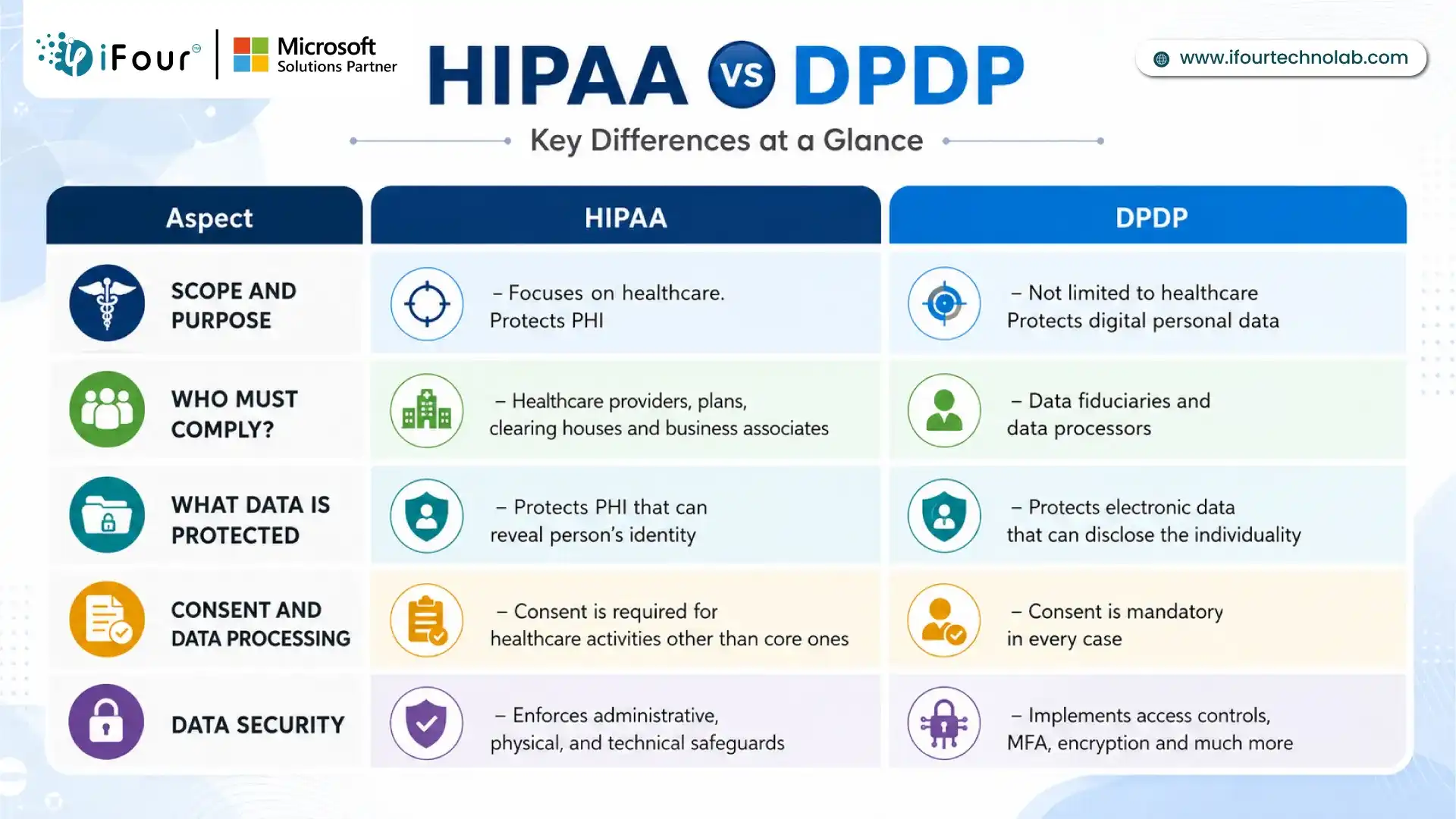
Although HIPAA and DPDP are both responsible for protecting personal patient data but they are worlds apart.
Scope and Purpose
HIPAA was established by keeping healthcare domain at center. It mainly cares about safeguarding Protected Health Information (PHI) which is handled by healthcare organization and associated stakeholders.
On the other side, DPDP extends beyond healthcare sector as it covers broader areas. It concerns about managing digital personal data, so healthcare falls directly under its guidelines.
Who Must Comply With?
As mentioned above, healthcare plans, healthcare clearing houses, healthcare providers and business associates must adhere to HIPAA.
Whereas DPDP Act applies to data fiduciaries as well as data processors.
What Data is Protected?
HIPAA covers information that can reveal individual identity and is handled by parties who are responsible towards HIPAA.
DPDP Act handles data which is in digital form and consists of parameters that can disclose a person’s individuality.
Empower community health clinics with smarter pediatric software solutions
Consent and Data Processing
Under HIPAA for core healthcare activities, there is no need to ask for permission every time. But for certain scenarios it is mandatory to take written confirmation from individuals.
DPDP is completely different in this basis. Data fiduciaries and data processors both need legal authority before processing personal data.
Individual Rights
Some of the personal privileges HIPAA gives are right to access, right to request correction, right to request restrictions, right to an accounting of certain disclosures, right to confidential communications and right to receive notice of privacy practices.
DPDP on the other hand provides right to access, right to correction and erasure, right to withdraw consent, right to grievance redressal and right to nominate.
Data Security
HIPAA requires healthcare organization and related entities to implement administrative (includes policies, risk management, employee training), physical (include facility, device and workstation security) and technical (includes access controls, authentication and audit controls) safeguards.
DPDP doesn’t divide security mechanisms into 3 areas just like HIPAA, but it includes measures like access controls, encryption, back & recovery services and much more.
To learn more about privacy, security, and compliance risks, check this webinar – “AI in Healthcare: HIPAA Compliance and Privacy Risks.”
Data Breaches
Under HIPAA, when the breach of PHI occurs the covered parties must assess the breach and notify the affected individual, HHS as well as media (optional).
According to DPDP Act, when digital personal data is compromised then it is mandatory to inform Data Protection Board of India and affected Data Principals.
Penalties and Enforcement
Violating HIPAA can result into monetary penalties, corrective actions, resolution agreements, or criminal consequences.
Compromising the guidelines stated under DPDP Act, might end up with financial penalties along with regulatory actions and other compliance repercussions.
HIPAA vs ABDM Health Data Management Policy
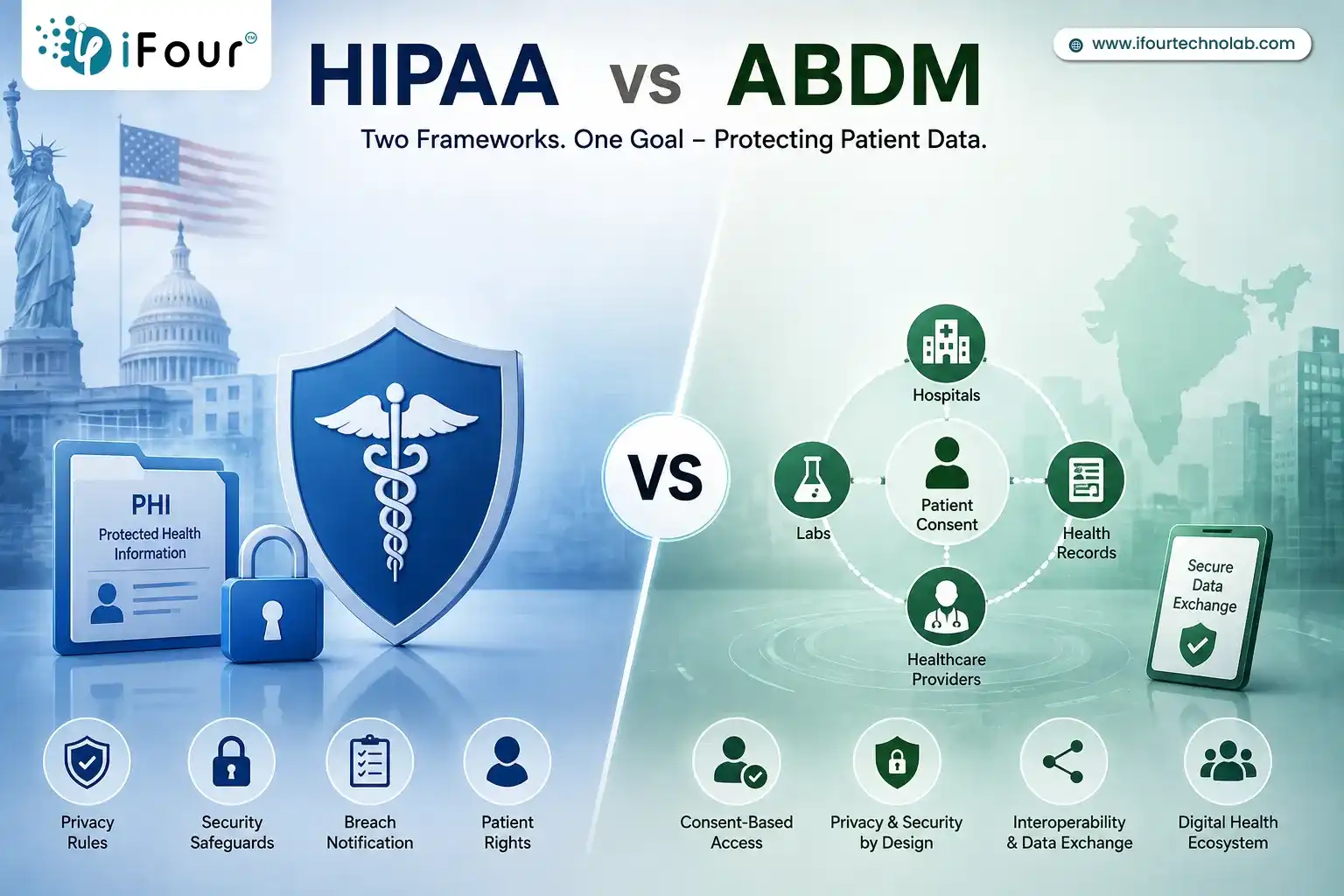
Both frameworks address security of patient data in healthcare sector but are different in the way they carry out their responsibilities.
What Is the ABDM Health Data Management Policy?
ABDM Health Data Management Policy is a legal standard developed by India’s Ministry of Health and Family Welfare. It is an integral part of Ayushman Bharat Digital Mission which involves the principles of privacy, security, consent and responsible managing of data within digital health ecosystem.
Track every child’s recovery progress with intelligent recovery score monitoring
What Type of Health Data Does ABDM Policy Address?
ABDM policy generally deals with:
- Patient identity related records
- Medical and health information
- Diagnostic and laboratory records
- Digital records that are shared between healthcare organizations
Privacy and Consent
Privacy rule under HIPAA controls the usage and disclosure of PHI. For activities other than TPO (Treatment, Payment, Operation), usage and disclosure of PHI require consent from respective individuals.
According to ABDM, consent is mandatory before making any actions on patient medical records.
Access and Data Sharing
HIPAA ensures that access to PHI must be limited based on the user’s role and authentication.
ABDM on the other side guarantees safe and consent-based data exchange between different healthcare organizations within digital healthcare ecosystem.
Data Security
HIPAA generally makes covered entities and business associates to implement administrative, physical and technical safeguards for regulating secure processing of ePHI.
Whereas ABDM policy enforces access control, multi-factor authentication, consent-based data handling, and secure data sharing to facilitate better data protection.
Interoperability and Health Information Exchange
HIPAA does not support interoperability instead it consists of some security-based regulations that can help in secure health information exchange.
ABDM allows multiple healthcare organizations to connect and share health information safely and securely based on consent.
Role of the IT Act in Indian Healthcare Data Security
IT Act was established for electronic information and cybersecurity purposes. It is not limited to only medical sector but can be applicable for healthcare providers dealing with electronic health information.
Why the IT Act Matters to Healthcare?
Nowadays healthcare organizations rely on digital health information. And IT Act 2000 helps to deal with any cyber threats which involve violation of electronic data.
IT Act and Protection of Electronic Data
IT Act controls issues related to electronic information and computer-based activities. In healthcare organization data lies within multiple software including EMR/EHR, HMS/PMS, LIMS, RIS, and much more,
So, to protect the data stored electronically IT Act addresses concerns related to unauthorized access, damage to computer devices, illegal downloading of data or other cybercrimes.
Make pediatric administration faster, smarter, and more efficient.
IT Act vs HIPAA
Purpose
- HIPAA – Controls the usage of PHI and provides multiple privileges to individuals
- IT Act – Protect electronic information and deals with cyberthreats
Scope
- HIPAA – Limited to healthcare sector (applicable in USA)
- IT Act – Covers all the domains involving e-data (applicable in India)
Type of Data
- HIPAA – Deal with PHI and ePHI
- IT Act – Deal with digital data stored decentrally
Data Breaches
- HIPAA – Enforces Breach Notification rule in case of violation
- IT Act – Addresses the violation with required action but does not have specific framework for data breach
Who Must Adhere to?
- HIPAA – Healthcare providers, healthcare plans, medical clearing houses and business associates
- IT Act – Organizations and individuals dealing with electronic information and computer resources.
Read More : How to Start a Pediatric Clinic in India
Understanding HIPAA and Indian Healthcare Data Regulations
Protecting patient data might be a shared responsibility but the path to achieving it can look different for both countries.
HIPAA vs Indian healthcare data regulation is not simply about comparing 2 legal standards – it is about understanding how different regulatory framework ensures privacy, security, consent and data handling.
For healthcare organizations, staying compliant means looking beyond one-size-fits-all approach and building data practices around specific requirements that apply to their operations.
Ultimately strong data protection is not about strictly adhering to regulatory standard – it is about earning and maintaining patient trust.
FAQs
There is no single Indian equivalent of HIPAA. Instead, healthcare data protection in India is governed through a combination of frameworks, primarily the Digital Personal Data Protection (DPDP) Act, 2023, the ABDM framework, and applicable IT and cybersecurity requirements.
Yes, the DPDP Act can protect patient health data when it qualifies as digital personal data and falls within the Act’s scope. However, it is important to understand that the DPDP Act is not specifically a healthcare-data law like HIPAA.
The DPDP Act focuses on the protection of digital personal data, ABDM focuses on privacy, consent, security, and exchange of health information within the digital-health ecosystem, while the IT Act contributes to the broader legal framework for electronic information and cybersecurity.
Yes. An Indian healthcare company can implement HIPAA compliance requirements, even though it is in India. HIPAA does not require an organization to be physically located in the United States; what matters is whether the organization falls within HIPAA’s definitions of a covered entity or business associate.
If healthcare data is breached in India, the organization may have to investigate and address the incident, notify affected individuals and the Data Protection Board where required, and take remedial security measures.
.webp)
Recent Posts


Why Paper Records Are Holding Pediatric Clinics Back?
September 03, 2026
Everything You Need to Know About Pediatric SOAP Notes
August 27, 2026
How AI Is Transforming Pediatric Healthcare
August 25, 2026HIPAA vs Indian Healthcare Data Regulations
August 24, 2026